Scaling
Technology & Teams
CTO for the AI age. I combine extensive experience with modern AI to build tech that actually works
I help scaling companies build the best technology. Whether it's integrating agentic AI or fixing your core systems, I focus on what delivers value, not just on what's trending.

By the Numbers
3
Start-up trade sales
$150M
PE investment valuation
0 - 100
Size of teams I have built
15 years
Systems I have created still running
$15B+
Portfolios managed by my systems
10M+
Monthly users of architectures I have created
> 70%
Measured productivity gain via AI strategy
100K
App users within 1st year
5.3x
Leadership for revenue growth
Latest Thinking
Insights on engineering culture, strategy, and scaling.
Ask an AI for a random number and you'll get 7
Most of what AI gets wrong comes down to how it was asked. A one-minute test shows why, and why the workaround you pay for today may be worthless after the next release.
AI wrote it. But is it right?
A language model can cite every number correctly and still reach a conclusion the data doesn't support. A numbers check won't catch it. Code that checks each claim can, shown on a real developer survey.
Who holds the loop? A series on LangChain and other agent frameworks
Three articles that build the same jobs with no framework, LangChain and LangGraph, Pydantic AI and the Claude Agent SDK, and compare what each one actually did.
Vibe coding vs software engineering: five gaps the model won't flag, and four questions to ask
Five gaps AI coding models won't flag: supplier lock-in, unguarded language-model calls, thin documentation, tests that skip the user's path, and repeated code.
Agent-ready is the new mobile-ready
The companies that designed for mobile beat the ones that bolted it on. AI agents are the same shift, and five questions tell you which of your tools are ready.
Four tools and no single view
Jira, Confluence and Atlas each held a slice of the picture at a different level of detail, so every week someone rebuilt the whole thing in PowerPoint.
Ways of Working
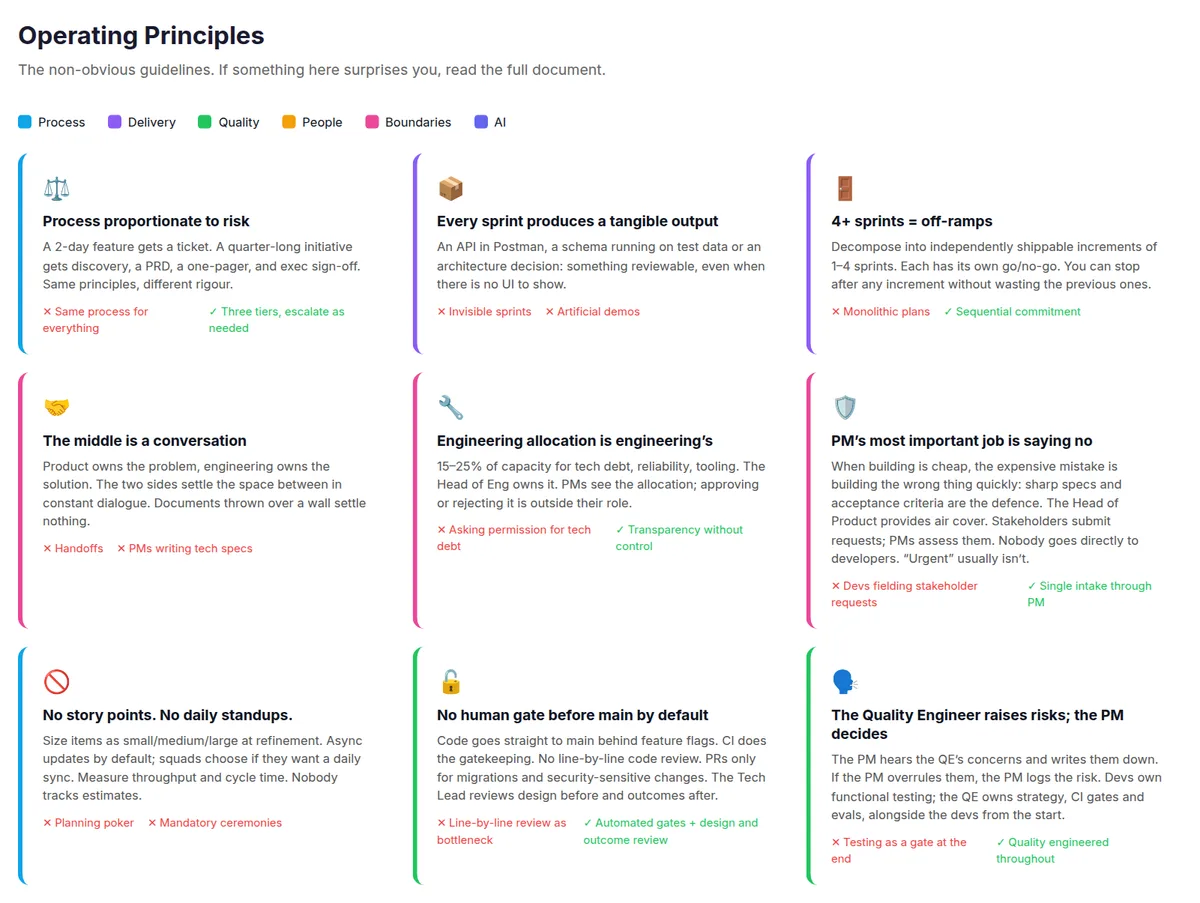
An operating model for a performant product and engineering organisation, built to solve real-world challenges and create a thriving team environment. How the squads are structured and who owns what, the sprint and release process, DevOps principles, product tiers, and where AI earns its place. It runs from a founding team of a few people up to 100, and you can set your team's size so every page shows the roles and org charts that fit. The principles never flex: one named owner for every responsibility, clarity about who decides, decisions written down, and a named person accountable for production.
Read the Ways of Working →